Eva Eis (Kremer Pigmente, Aichstetten) and Almut König (Bayerische Akademie der Wissenschaften, München; Friedrich-Alexander-Universität, Erlangen-Nürnberg)
Poster at the ATSR conference in Lissabon (2025)
Introduction
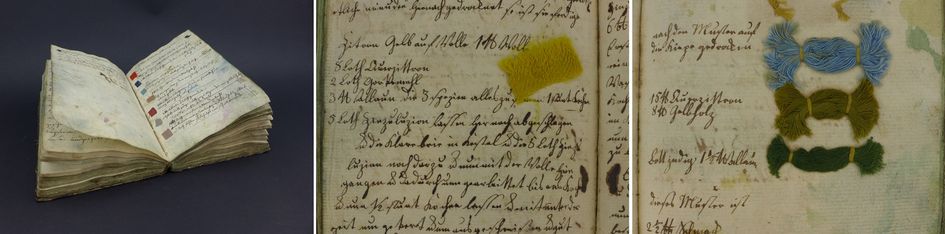
In Dr. Georg Kremer´s collection of literature, sample books and other historical sources there is a recipe book of unknown origin. The pages are old and worn, covered with ink and traces of colour. This source has never been studied before. The collection of recipes, notes and samples from a dyer can be dated back to the early 19th century.
Handwriting
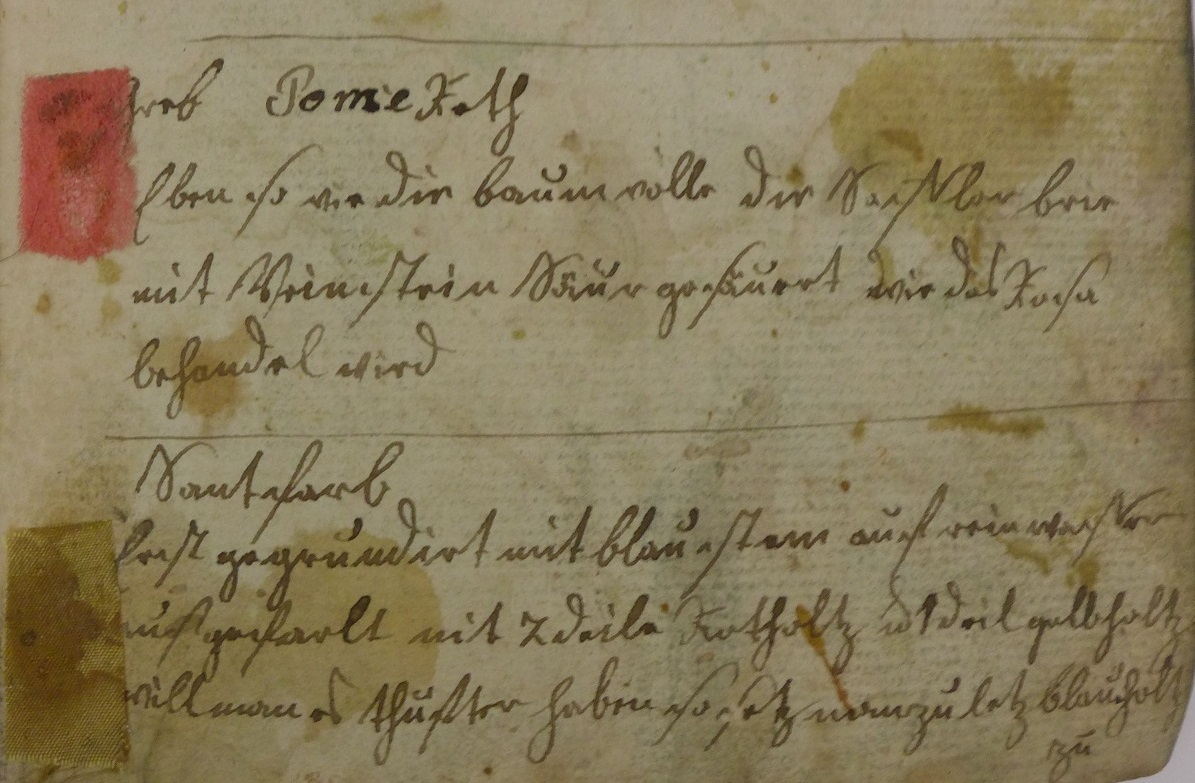
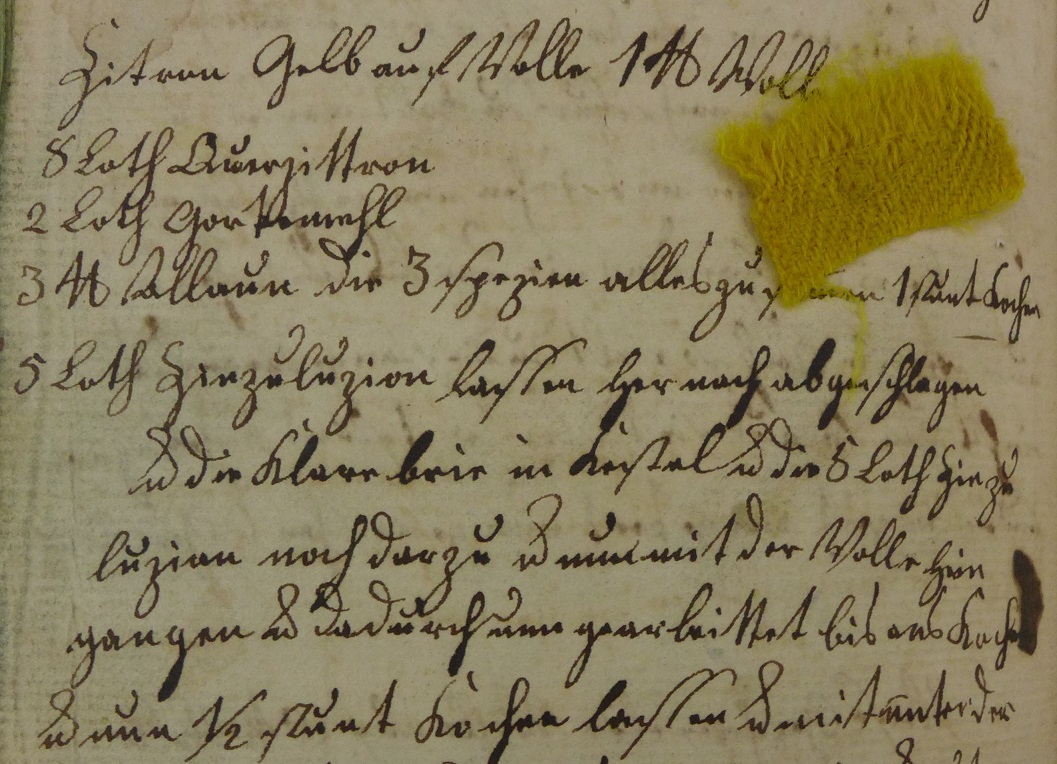
The recipes are handwritten in old German script. Even for native speakers, this source poses unusual challenges. The handwriting itself is relatively uniform and easy to decipher. The letters show peculiarities which indicate that the book was written by one practiced hand only. But this writer put down his notes using spoken language. In addition, he or she constantly changed the spelling of the same words. Sometimes, the writer used foreign terms, but without knowing how to spell them, which makes them hard to identify (Fig. 1). At least ten variations of the word cochineal can be found in the book (Fig. 2). Ingredients as well as measures and tools can be difficult to trace. Furthermore, the lack of punctuation and the inconsistent use of uppercase and lowercase letters makes the whole text hard to read and puts common editing rules to a test.
Orthographic variation or dialect?
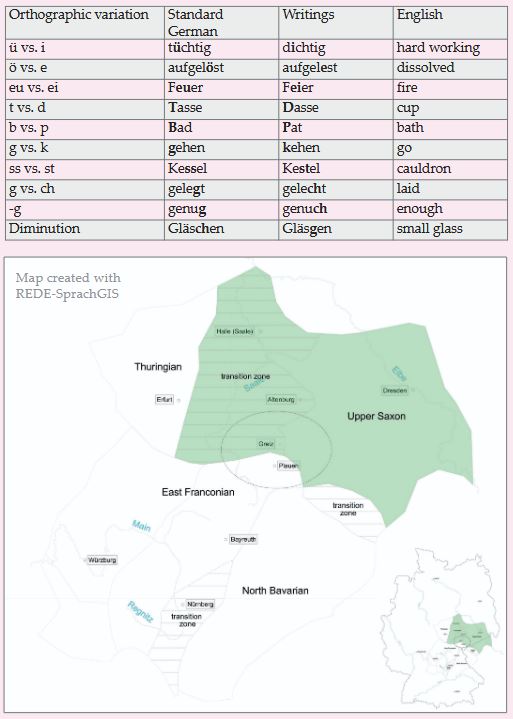
The spelling suggests that this dyer spoke a local dialect. Although a writer’s orthography does not reflect his or her dialect, the orthographic variations can be interpreted as an indication of linguistic and geographical origin. The spelling shows signs of de-rounding (ü, ö, eu > i, e, ei) as well as Binnendeutsche Konsonantenschwächung, a process of sound change in which the opposition between lenis and fortis consonants is largely abolished, so that, for example, /t/ is pronounced as /d/. This could be the reason why the dyer writes “Tasse, Bad, gehen” as well as “Dasse, Pat, kehen”.
This and other features such as the t-epenthetic after the fricative /s/ and the spelling of “g” as “ch” suggest an origin in the northern Upper East Franconian, south-eastern Thuringian and south-western Upper Saxonian dialects (see map). Morphological features such as the occasional use of the diminutive ending -chen, the e-ending in the dative case e.g. “über einem Wasserbade” (above a water bath) and predicative adjectives e.g. “spielt es reine an Wasser” (rinses it clean by Water) point more strongly to the Upper Saxon area [1-6].
Contents
While inconsistencies in writing style may suggest an uneducated author, the contents of the book convey another message. Detailed descriptions in the recipes indicate that this writer was an experienced dyer. The way the reader is addressed gives the impression that the instructions were written for someone particular. The outline of the various recipes is not always clear, as if the dyer spontaneously remembered a procedure and added it during the writing process.
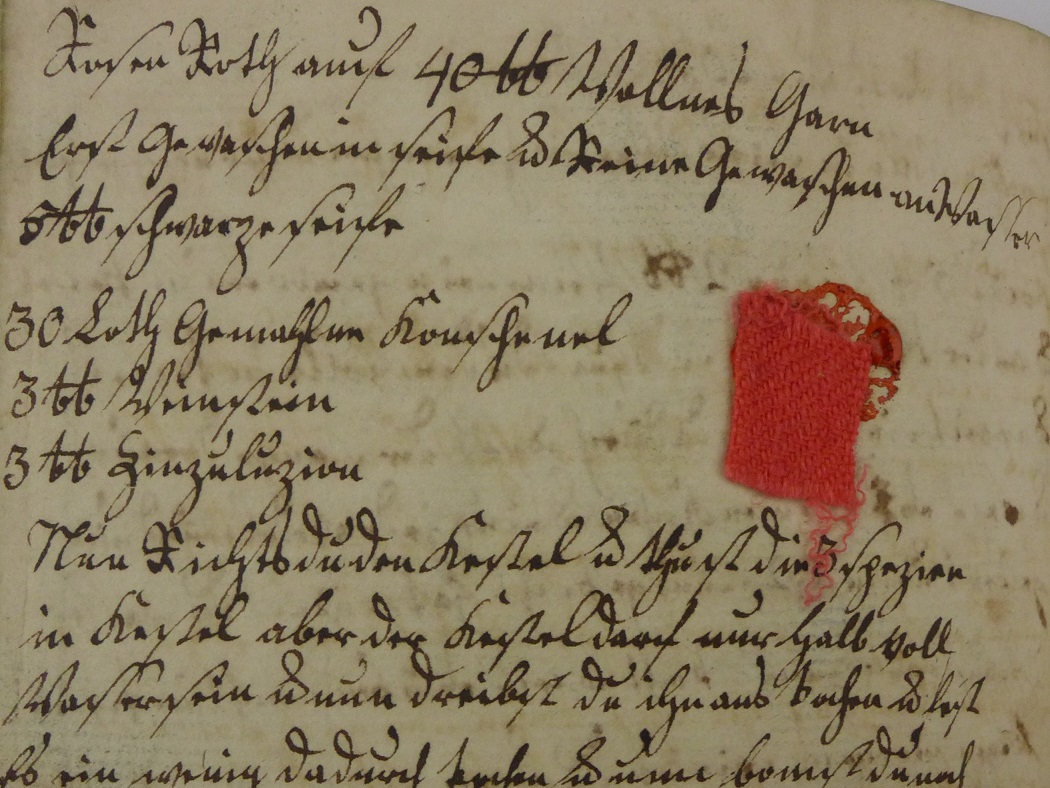
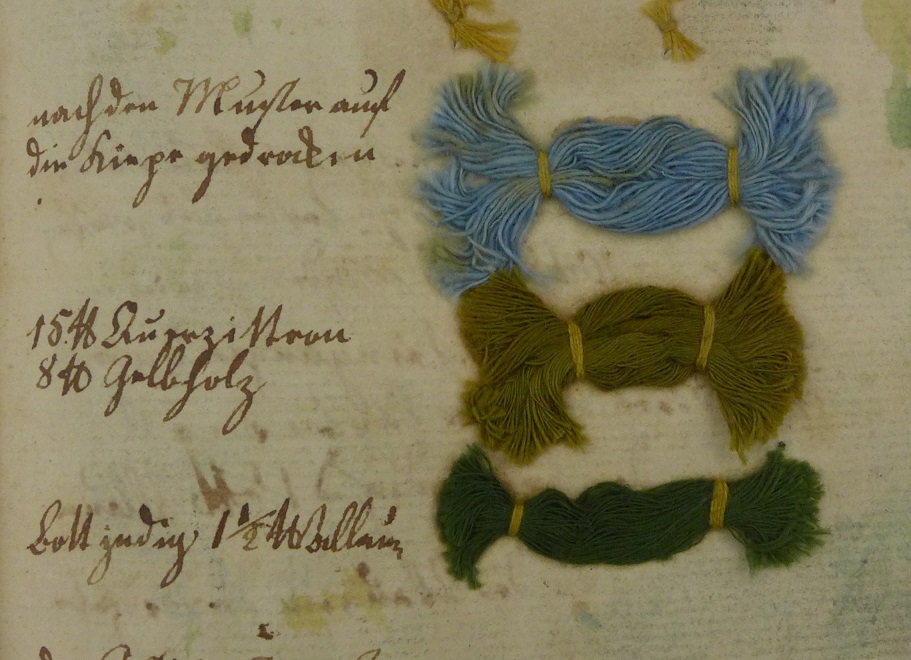
Still, the recipes are quite well sorted. The first part of the book contains recipes for dyeing cotton yarn, followed by instructions for dyeing and printing wool and silk. The next part of the book contains recipes for dyeing wool yarns, wool and silk fabric. Dyed samples were either sewed or glued to the pages and demonstrate the results of the recipes (Fig. 4). Apart from that, there are notes on the preparation of chemicals as well as a sketch for a drying frame.
A wide palette of natural dyes was used: alkanna, buckthorn berries, cochineal, cutch, fustic, (woad) indigo and indigotin, logwood, lac, madder, orchil, orlean, redwood, safflower, salvia leaves, sumac, turmeric, weld, yellowwood and quercitron (Fig. 5). In addition the dyer used inorganic pigments like Prussian blue and chrome yellow.
Dating
Since the book does not contain any dates, the time frame can only be narrowed down by means of the ingredients and measures used. The use of quercitron and chrome yellow indicates that the book was written in the early 19th century. Quercitron became more readily available after the Continental Blockade [7]. In the printing recipes, the dyer also uses chrome yellow. Although chrome yellow was introduced as an artist pigment in the early 19th century, it did not find widespread use in textile printing before 1820 [8]. The writer gives another important hint by mentioning that all measures are Saxonian units of measurement. These were replaced by the Zollpfund (German Customs Pound) in 1840, although it cannot be ruled out that they were still in use for some years afterwards [9-10]. Thus, the book might have been written between 1820 and 1840 or a few years later.
Outlook
Transcribing the handwritten source and narrowing down its place of origin was essential for future use of the recipes. It is envisaged to make the source available for scientific research on the Kremer Pigmente website.
Note:
These recipes from the 19th century are no longer suitable for practical use in dyeing textiles. Many of the ingredients are toxic, and reproducing these recipes without appropriate safety precautions can be very dangerous. You can find contemporary recipes, ingredients, and literature on textile dyeing on our website.
Further information:
Article in MDPI by Eva Eis, published: 30. April 2026
> Dyeing with a Coffee Cup? Challenging Recipes from a 19th-Century Dyer’s Handbook
Article by Erica Couto, published May 25, 2026 (in Spanish)
Descubren el cuaderno secreto de un tintorero sajón del siglo XIX con 168 recetas de tintes que hoy vuelven a funcionar.
Un cuaderno de tintorero anónimo con 80 muestras de tejido cosidas revela los secretos del color en los albores de la Europa industrial. La ciencia moderna ha logrado reproducir algunos de ellos con éxito.
