Recette: French Logwood Ink
This ink has a beautiful bluish-black hue. Freshly applied, it is pale grey, but becomes much darker while drying. When exposed to light, it only fades slightly, loses its blue tint and becomes blacker.
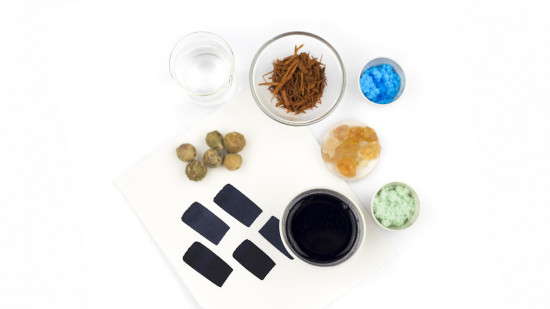
Traitement
French logwood ink forms a sediment, especially when it is fresh. It is best to let it sit for a while and clarify.
Prolonged storage may cause the formation of a skin on the surface of the ink, which can be skimmed off or filtered.
Remarque
The production requires the following tools: a scale, mortar and pestle, an enameled pot, glass rods or wooden sticks for stirring, glasses, funnels and filters.
Water
Only demineralized water (#65000) is used in the recipes.
Color result
Since many ingredients used in ink recipes are of natural origin, the color result may vary. Deviations from the original recipe may also change the result.
Filtration
The inks are filtered with paper filters.
Cooking
Keep the cooking pot closed with a matching lid.
Shelf life
Moldy ink should not be skimmed off. Please dispose if the ink.
Cleaning
Pots are best cleaned with hot water and a small amount of citric acid (#64150).
