#10000
Smalt, standard
according to a recipe from 1820, 0 - 120 µ


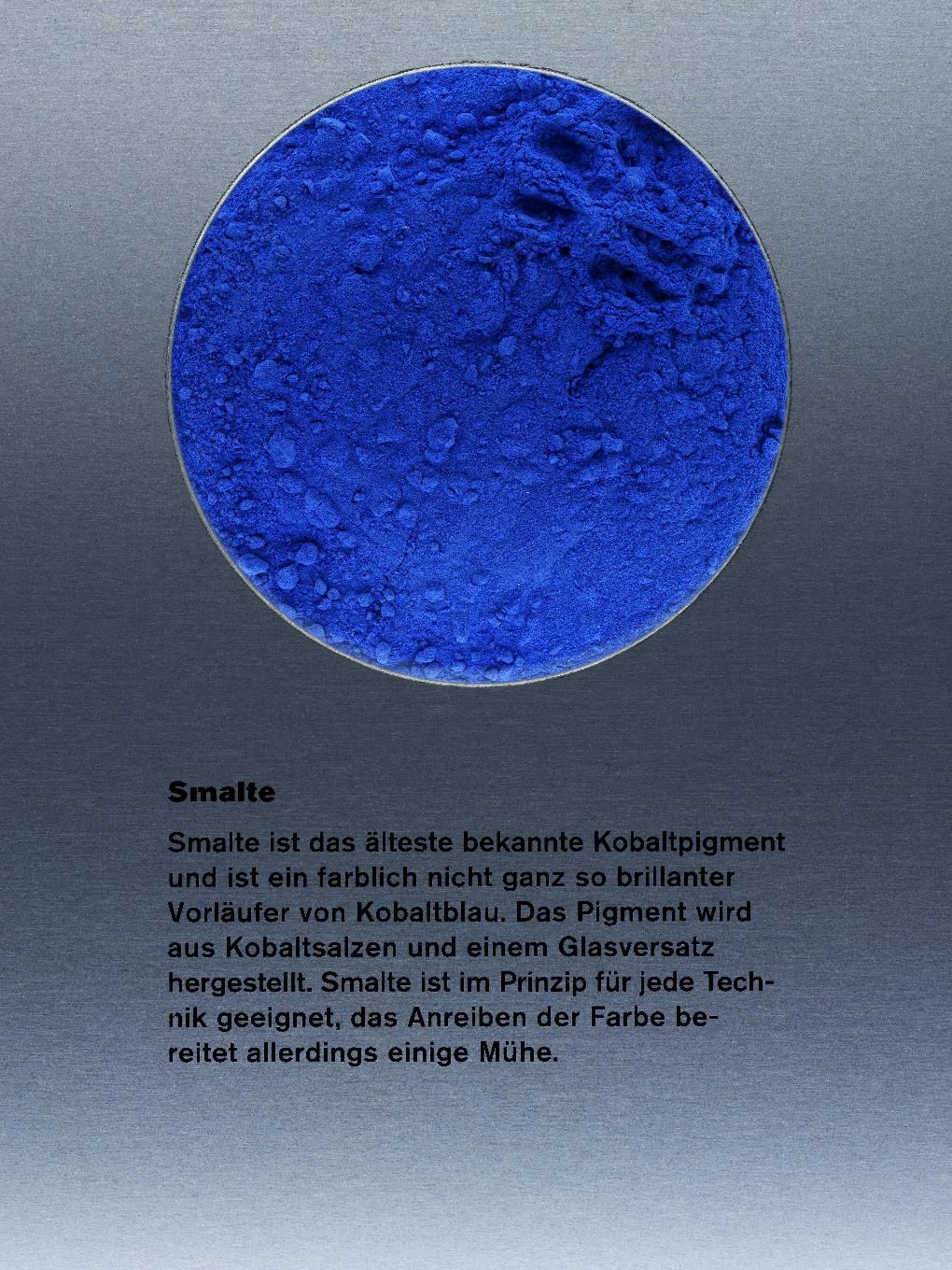
Buy Smalt, standard:
Ordering information
Follow the safety information!
Please read the material safety data sheet (MSDS)
Safety Data Sheet 10000_SDS.pdf
Own production Further products by Kremer Pigmente
Safety Information

GHS08-2
Health Hazard
Signal word: Danger
H373: May cause damage to organs through prolonged or repeated exposure.
P102: Keep out of reach of children.
P260: Do not breathe dust/fume/gas/mist/vapours/spray.
P304+P340: If inhaled: Remove victim to fresh air and keep at rest in a position comfortable for breathing.
P342+P311: If experiencing respiratory symptoms: Call a poisson center or physician.
P501: Dispose of contents/ container according to regional, national and international regulations.
Smalt is the oldest known man-made cobalt blue pigment. The term “smalt” comes from the Italian word “smaltare”, which means „to melt“. Smalt is a potash silicate strongly colored with cobalt oxide, which is melted, quenched, and ground to a powder. The origin of smalt is obscure, but recent studies have shown that cobalt was already present in ancient Egyptian blue glass. However, there is no evidence that powdered cobalt glass was ever used as a painter’s pigment in ancient times. It is unknown when cobalt was first used in Europe. We do know that around the middle of the 15th century, cobalt minerals were discovered near the border of Bohemia and Saxony. In German Renaissance and Baroque painting, the pigment smalt played an important role, particularly for the depiction of air in frescos. Due to the vast industrial production of new, more stable blue pigments, the knowledge surrounding smalt was almost lost at the beginning of the 20th century.
Smalt was the first historical pigment (re)created by Georg Kremer in 1977. The rediscovery of this ancient cobalt blue initiated the founding of Kremer Pigmente the same year. Today, Kremer Pigmente is the world’s only manufacturer of smalt, which is produced according to a recipe from 1820.
Downloads
- Chemical description: Cobalt potassium silicate glass. Pigment Blue 32, C.I. 77365
- Resistance to alkali: 5 (1 is bad, 5 is best)
- Resistance to lime: 5 (1 is bad, 5 is best)
- Resistance to acid: 3 (1 is bad, 5 is best)
- Chemical Formula: Glas
- Lightfastness - thinned: 8 (1 is bad, 8 is best)
- Lightfastness - medium: 8 (1 is bad, 8 is best)
- Lightfastness - concentrated: 8 (1 is bad, 8 is best)
- ColorIndex: PB 32.77365
- Opacity: transparent
- Suitability: Acrylics, Ceramic, Lime / Fresco, Tempera
- Colors: Blue
- Forms: powder
- Solubility in water: insoluble

-
For which application / techniques is Smalt, standard suitable?
Smalt, standard is suitable for Acrylics, Tempera, Lime / Fresco, Ceramic -
What color has Smalt, standard?
Smalt, standard has the color Blue. -
What Colorindex has Smalt, standard?
Smalt, standard has the Colorindex PB 32.77365. -
How lightfast is Smalt, standard?
Smalt, standard has the lightfastness thinned = 8, medium = 8, concentrated = 8 (1 is bad, 8 is best).