Receta: Coloring Epoxy Resin

Epoxy resins are synthetic resins that can be reacted with a hardener. As with all reaction resins, the resin-hardener ratio must be kept extremely accurate during mixing - otherwise parts of resin or hardener will remain without reactants. These remain behind and the crosslinking remains incomplete, which can lead to a soft product and sticky surfaces.
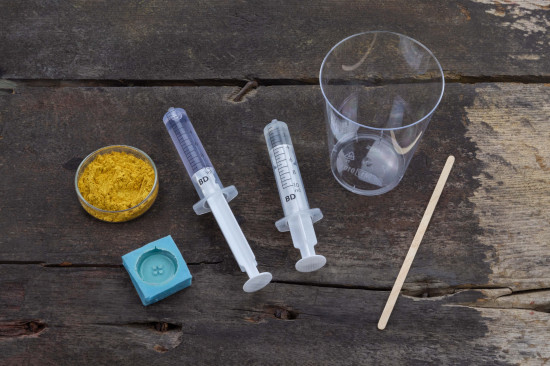
Procesamiento


In principle, pigments are insoluble in epoxy resins, but they can be worked into the material. How well a pigment is dispersed in resin varies: It depends both on the kind of resin and on the pigment itself. Runny resins will blend better with pigments than thick ones. If you use a fast-drying epoxy resin set, it is better to first mix the pigment with the resin before adding the hardening fluid. Always follow the mixing ratio as described for the respective product. Paso 1: In principle, pigments are insoluble in epoxy resins, but they can be worked into the material. How well a pigment is dispersed in resin varies: It depends both on the kind of resin and on the pigment itself. Runny resins will blend better with pigments than thick ones. If you use a fast-drying epoxy resin set, it is better to first mix the pigment with the resin before adding the hardening fluid. Always follow the mixing ratio as described for the respective product.
Usually, coarse-grained pigments, metal powders, glass flour and sands can be worked into the resin easily. Pearlescent pigments, glimmers and the like blend well with resin. Very fine powders tend to form lumps when mixed with resin and thus require thorough grinding (mortar and pestle or glass muller and glass palette) until the pigments are fully dispersed without lumps. This holds true for all fine pigments, such as cobalt pigments, iron oxide pigments and, even more so, syntheticorganic pigments. If pigment agglomerates remain in the resin, they may prevent it from hardening! The amount of pigment you need to add depends on the kind of resin and on the pigment. Thus, pretests prior to the application are highly recommended. Please note that filled resin already contains aggregates and therefore binds smaller amounts of pigment. If the amount of pigment added is too high, bonding and stability of the resin may be affected! Paso 2: Usually, coarse-grained pigments, metal powders, glass flour and sands can be worked into the resin easily. Pearlescent pigments, glimmers and the like blend well with resin. Very fine powders tend to form lumps when mixed with resin and thus require thorough grinding (mortar and pestle or glass muller and glass palette) until the pigments are fully dispersed without lumps. This holds true for all fine pigments, such as cobalt pigments, iron oxide pigments and, even more so, syntheticorganic pigments. If pigment agglomerates remain in the resin, they may prevent it from hardening! The amount of pigment you need to add depends on the kind of resin and on the pigment. Thus, pretests prior to the application are highly recommended. Please note that filled resin already contains aggregates and therefore binds smaller amounts of pigment. If the amount of pigment added is too high, bonding and stability of the resin may be affected!
In contrast to pigments, colorants are soluble in epoxy resin. The resulting color is more transparent, but less lightfast. All Solvent Dyes are suitable for coloring epoxy resin. They usually blend easily with the resin. However, if you add too much colorant, it will not fully disperse and little lumps will remain in the mixture. Paso 3: In contrast to pigments, colorants are soluble in epoxy resin. The resulting color is more transparent, but less lightfast. All Solvent Dyes are suitable for coloring epoxy resin. They usually blend easily with the resin. However, if you add too much colorant, it will not fully disperse and little lumps will remain in the mixture.

Ingredientes

ARALDITE® 2020-1 Set (#97920)
Resina epoxídica, estable a los rayos UV (#97850)
Alternativa:
HXTAL NYL-1, resina (#972501)
0-5 % Pigmento
0-1 % Dye

Información adicional

Nota

Epoxy resins are rather aggressive binders, so only very stable pigments are suitable for their coloring. Yellowish resins and filled resins with a strong color of their own may affect the resulting color and make coloring more difficult. In order to achieve a certain color hue, pretesting is always necessary, because the epoxy resin may alter the color of the pigment. In some cases, it may be necessary to sand and/or polish the surface of the colored epoxy resin layer when dried and cured. WARNING Epoxy sanding dust and vapours are toxic. When working with epoxy (not just during sanding), always wear protective equipment, including eye protection, respirator or dust mask, gloves, and protective clothing.

Kremer Pigmente no se hace responsable del resultado de aplicación de los procesos aquí descritos. En todos los casos, recomendamos la realización de pruebas previas a cualquier aplicación definitiva

Lista de productos