Receta: Oil Paint

Pigments are small particles, which often stick together like tiny magnets. If you just mix the pigment with linseed oil (the most common plant oil used as binding medium for artists’ paint), lumps will remain in the paste, which can lead to chalking. For the stability of oil paint it is crucial, that each pigment particle is thoroughly wetted by the oil liquid. Therefore, pigments have to be ground most carefully and thoroughly whilst being mixed with the oil to form a homogeneous and lump-free paste.
Procesamiento
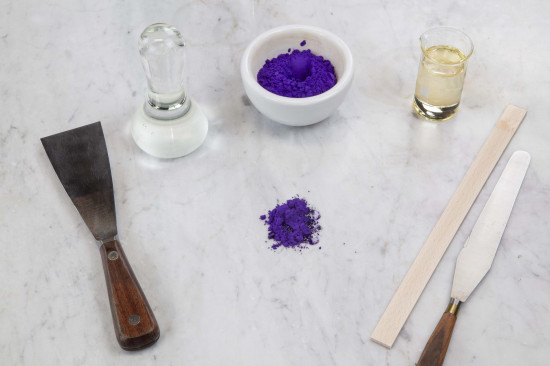
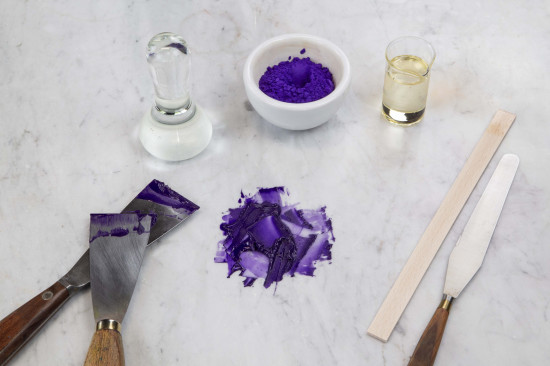
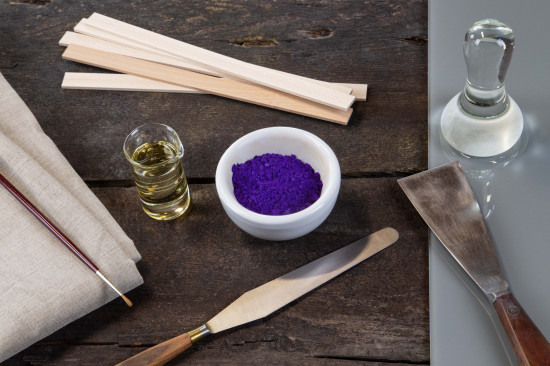
Slowly work the pigments into the oil until they form a paste with a putty-like viscosity. Paso 1: Slowly work the pigments into the oil until they form a paste with a putty-like viscosity.
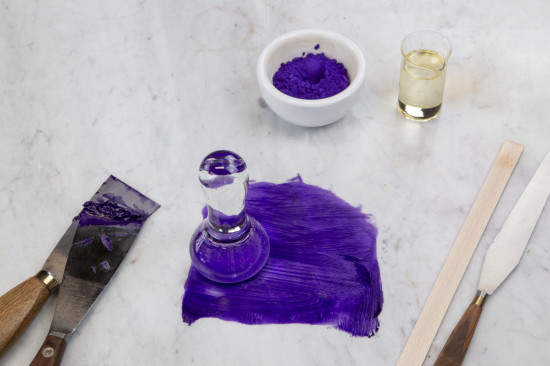
For grinding, use the palette knife, a small painter’s spatula, a glass muller and a glass or marble plate. Paso 2: For grinding, use the palette knife, a small painter’s spatula, a glass muller and a glass or marble plate.
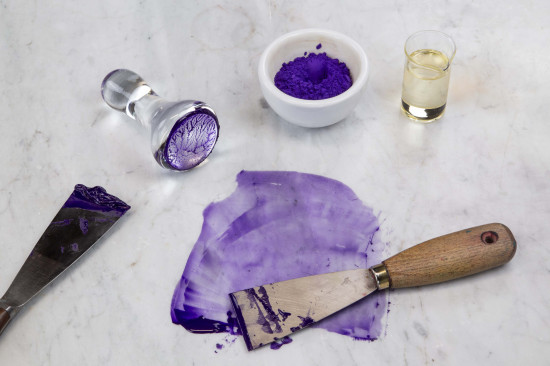
Now put a small portion of the color paste in a thin layer onto the glass or marble plate and keep grinding with the glass muller until all pigment particles are thoroughly wetted by the oil and are evenly mixed. Paso 3: Now put a small portion of the color paste in a thin layer onto the glass or marble plate and keep grinding with the glass muller until all pigment particles are thoroughly wetted by the oil and are evenly mixed.
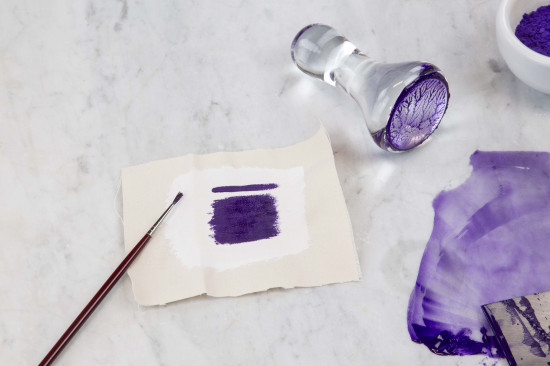
The oil paint should form a lump-free, homogeneous and stiff (not runny!) paste with a viscosity like tooth paste. Paso 4: The oil paint should form a lump-free, homogeneous and stiff (not runny!) paste with a viscosity like tooth paste.
It is possible that the oil paint becomes thicker/stiffer or thinner while grinding. In either case, the recipe should be modified accordingly, by adding more oil or more pigment. The pigment-oil ratio is most effective if some drops of oil turn the color more liquid but the addition of pigment will then turn the mixture crumbly. Paso 5: It is possible that the oil paint becomes thicker/stiffer or thinner while grinding. In either case, the recipe should be modified accordingly, by adding more oil or more pigment. The pigment-oil ratio is most effective if some drops of oil turn the color more liquid but the addition of pigment will then turn the mixture crumbly.
Put your fresh oil paint into a container. You can keep the paint from drying by covering it with a thin layer of oil or by covering it with a plastic wrap - or you can fill the paint into tubes (see Recipe: How to fill oil paint into tubes). Most pigments are suitable for oil painting. Exceptions are pigments unstable in oil, e.g. copper pigments. Please consult our „Pigment Suitability List“ for further information. Some pigments, like pearlescent pigments, or Azurite and Malachite, should not be ground too much and too finely, otherwise their crystalline surface will be destroyed and their color brilliance is lost. Also, light colors, such as Zirconium Cerulean Blue, work less well with linseed oil (which holds true for pretty muchall blue color hues), because even a slight yellowing of the
containing oil will change the delicate blue color of the paint. Paso 6: Put your fresh oil paint into a container. You can keep the paint from drying by covering it with a thin layer of oil or by covering it with a plastic wrap - or you can fill the paint into tubes (see Recipe: How to fill oil paint into tubes). Most pigments are suitable for oil painting. Exceptions are pigments unstable in oil, e.g. copper pigments. Please consult our „Pigment Suitability List“ for further information. Some pigments, like pearlescent pigments, or Azurite and Malachite, should not be ground too much and too finely, otherwise their crystalline surface will be destroyed and their color brilliance is lost. Also, light colors, such as Zirconium Cerulean Blue, work less well with linseed oil (which holds true for pretty muchall blue color hues), because even a slight yellowing of the containing oil will change the delicate blue color of the paint.

Ingredientes

1 parte(s) Aceite de linaza, prensado en frío (#73054)
Aceite de nueces, refinado (#73500)
Alternativa:
Aceite de linaza, sueco (#73020)
1-3 parte(s) Pigmento
Glass plate
Moleta

Información adicional

Nota

The color can be extended with fillers like Blanc Fix. Claytone®APA will thicken the oil color - even more when adding some drops of Ethanol. Grinding ultramarine pigments will work more easily when adding 1 - 4% of wax-paint medium.

Kremer Pigmente no se hace responsable del resultado de aplicación de los procesos aquí descritos. En todos los casos, recomendamos la realización de pruebas previas a cualquier aplicación definitiva

Lista de productos

Autor: Kremer Pigmente